Guide

The best budget-friendly education software for independent K-12 schools runs admissions, enrollment, the student information system, and tuition payments on one record, and lands somewhere around $3 to $8 per student per month once you count everything you’ll actually use. On that test, Sycamore is the strongest all-around value at a published $4 per student per month with every module included. Gradelink is the friendliest choice for very small schools that want month-to-month terms. FACTS makes sense if you already run FACTS Tuition. Veracross and Blackbaud are excellent and priced for larger schools with bigger teams. QuickSchools, SchoolCues, and ClassReach publish low entry prices for small and niche schools, and Alma and Rediker fill specific gaps. The ten are below, with what each costs, who it suits, and where it falls short.
Fair warning before you read on: I sell Sycamore, and it’s first on this list. I’ve tried to write the other nine the way their happiest customers would describe them, and I’ve kept the places where they beat us. If you’d rather see it all on one page, our SIS comparison guide (PDF) lays out the main platforms side by side, including a row for where each competitor wins.
Because most school management software wasn’t built for them. The biggest systems in K-12 were designed for public districts, where state reporting is the hard problem and nobody bills a family for tuition. Independent schools have the opposite problem. They’re small businesses that admit, enroll, bill, collect, discount, and report to a board, and small private school administration usually means a business office of one or two people.
And they really are small. Two out of three U.S. private schools enroll fewer than 150 students, according to the National Center for Education Statistics, and 40 percent enroll fewer than 50. A district platform asks a school that size to pay for capability it will never touch, then still sends it elsewhere for tuition. A free gradebook goes the other way and leaves admissions and billing in spreadsheets. Somewhere between those two is the range this list is about.
We kept the bar simple: about $3 to $8 per student per month, all-in. “All-in” is doing most of the work in that sentence. It means the license plus onboarding, payment processing, every module you’ll use, and the staff time to learn it. A platform with a low license and five paid add-ons is often the expensive one.
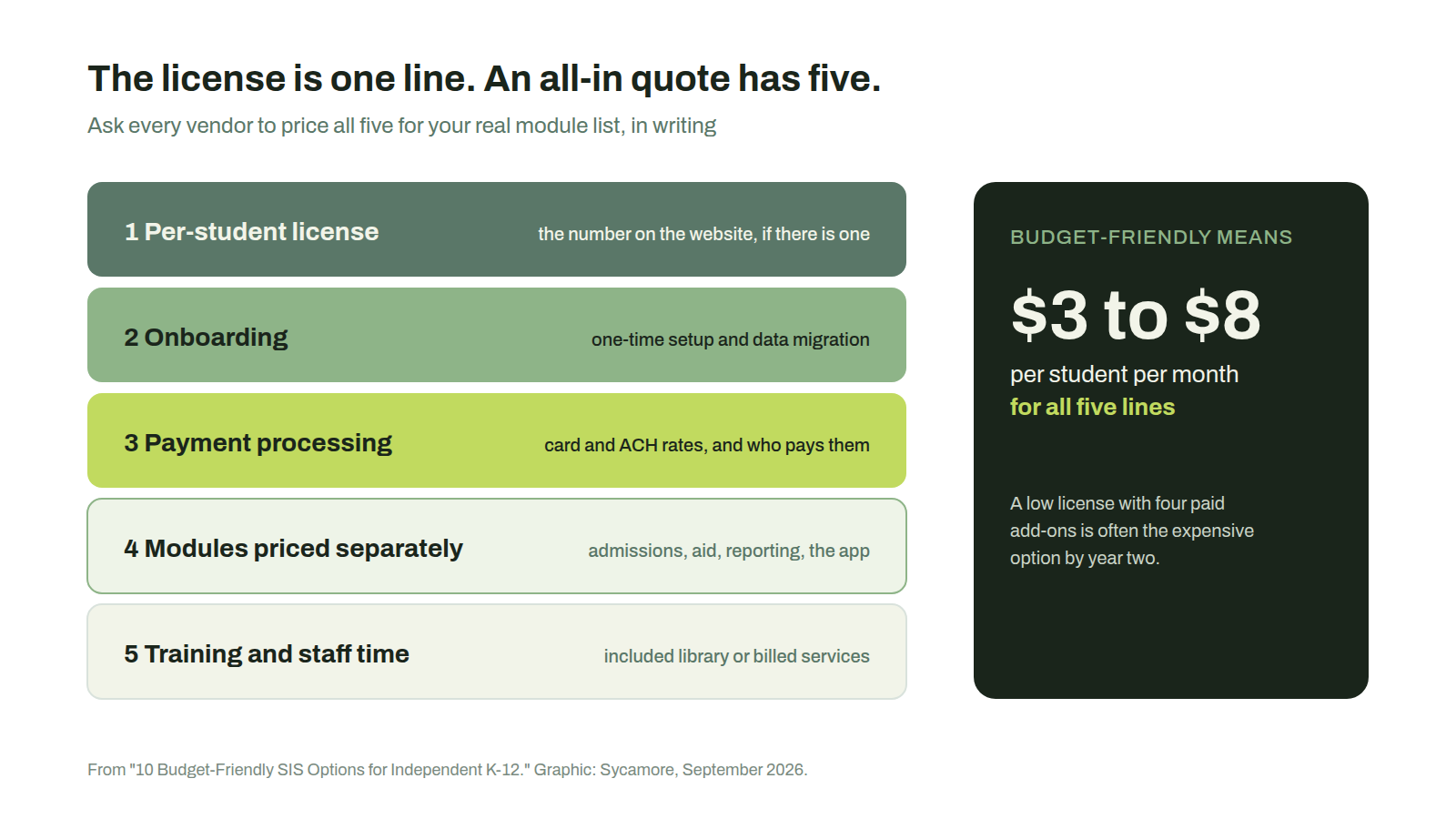
Beyond cost, we looked at five things a small independent school feels every week. Coverage first: do admissions and enrollment management, the SIS, and tuition billing and payments live in one system, or are you bolting on a third party for money? Then fit, meaning whether the product was built for private schools or retrofitted from district software. Time to value matters a lot when one person runs the office. So does the family experience, especially whether a parent can see grades and pay a bill behind one login. And support: a school without IT staff borrows the vendor’s support team, so we cared who answers the phone.
| Platform | Best for | Pricing model | Admissions and enrollment | Tuition and payments | Contract |
|---|---|---|---|---|---|
| Sycamore | Independent and faith-based schools, about 50 to 1,200 students | Published, $4 per student per month, all modules | Native | Native; school picks who pays fees | 18-month minimum, no auto-renew |
| Gradelink | Small schools that want simplicity | Quote (stopped publishing in 2026) | Paid add-on (EnrollMe) | Basic ledger; PaySimple processing | Month to month |
| FACTS | Faith-based schools already on FACTS Tuition | Quote, modular by product | Separate product | Native and mature | Annual, per module |
| Veracross | Larger independents with staff to run it | Quote, premium | Native | Native billing; processing through integrations | Annual |
| Blackbaud K-12 | Larger schools with development offices | Quote, enterprise | Separate product | Tuition Management (separate product) | 3 years, auto-renewing |
| Alma | Interface-first independents and charters | Quote | Native (AlmaStart) | Native fees module | Not published |
| SchoolCues | Micro-schools under about 75 students | Published, from $75 a month | Native | Native, recurring plans | Not published |
| QuickSchools | Schools that want low published per-student pricing | Published, $0.99 to $2.99 per student per month | Limited | Add-ons | Advertises no contract |
| Rediker | Established schools with custom workflows | Quote, per module | Native (AdmissionsPlus) | Native (FINACS) | Not published |
| ClassReach | Classical Christian and Catholic micro-schools | Published flat monthly tiers | Through configurable forms | Native | Not published |
Pricing reflects each vendor’s own public materials as of late September 2026. Packaging changes, so confirm with the vendor before you decide.
Sycamore is an all-in-one platform built for independent and faith-based K-12 schools. Admissions and enrollment, the full SIS (attendance, grades, scheduling, report cards), parent communication, a native iOS and Android parent app, and tuition billing and payments all run on one record. We’ve been at this since 2001 and are in the middle of a platform redesign, so you get two decades of school workflows in a newer interface.
The price is $4 per student per month, published, with every module included: SIS, admissions, communication, the parent app, the Sycamore Academy training library, and unlimited US-based support. Onboarding carries a low standard fee based on school size, discounted for schools in a district, diocese, or group, and volume pricing starts above 400 students. Contracts start at an 18-month minimum, longer terms lock the rate, and there’s no multi-year auto-renewal.
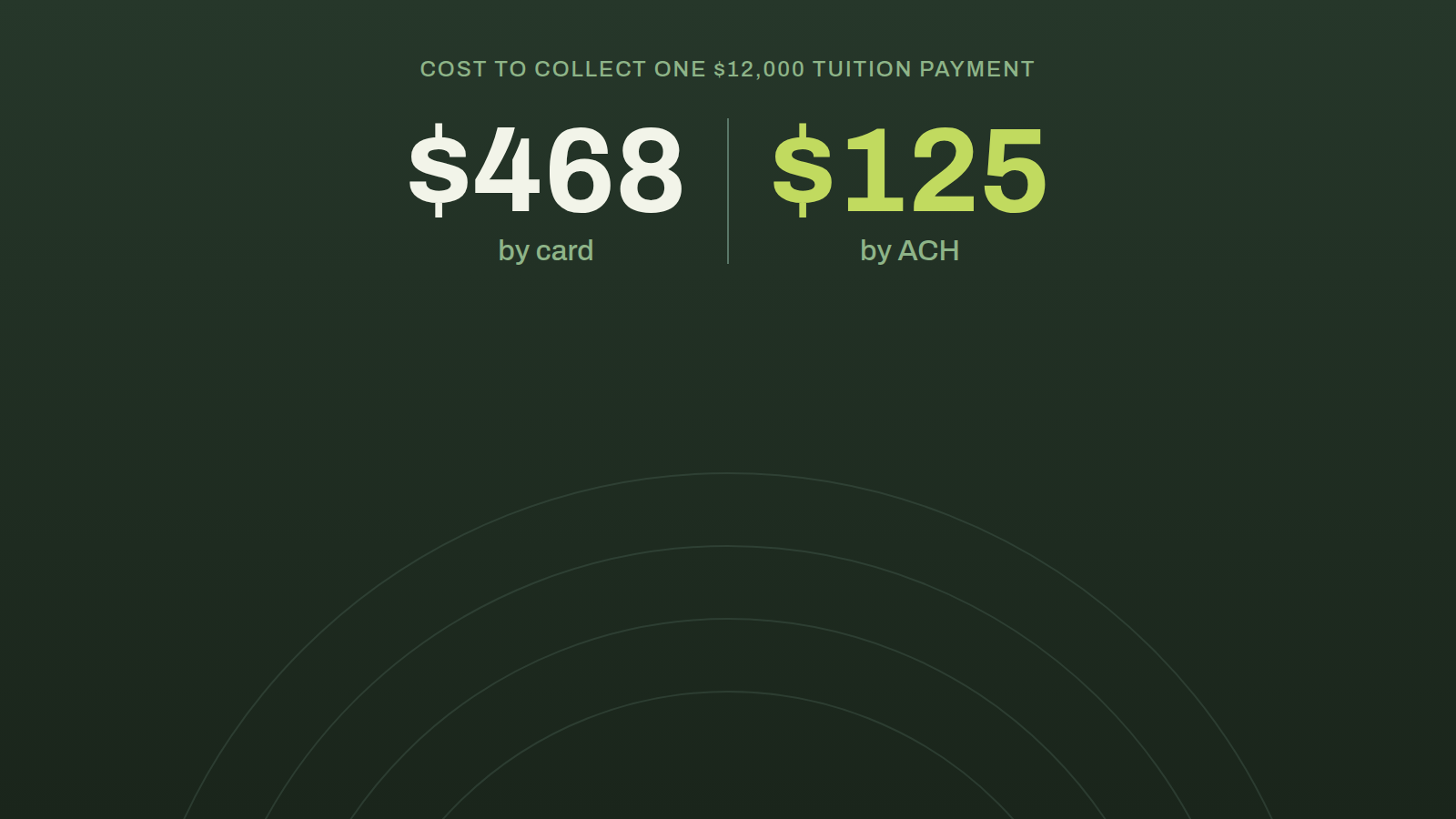
Payments have been native since we acquired TuitionEP in 2025. Cards run 2.9 percent plus 30 cents to the processor plus a 1 percent Sycamore convenience fee, so 3.9 percent plus 30 cents in all. ACH runs 0.8 percent capped at $5, plus the same 1 percent. The school decides who covers it: the school, the family, a split, or a mix by method. Tuition refund protection through Vertical Insure was added in 2026, and the platform publishes a live status page.
Where we’d point you elsewhere: if your advancement office lives in Raiser’s Edge, if you need Veracross-grade scheduling for a big upper school, or if month-to-month terms matter more to you than anything else.
Gradelink is the platform we’re compared to most, and it earns it. The parent app is one of the best rated in the category, the support team is consistently praised, and the SIS, gradebook, attendance, and report cards are easy to learn at a 60-student school where the office manager is also the registrar. It’s month to month, which beats our 18-month minimum on flexibility.
Two things to price carefully. Admissions (EnrollMe) and SMS are paid add-ons, and tuition is a basic accounts-receivable ledger with payments processed through PaySimple, so the all-in number climbs as the school grows. And Gradelink stopped publishing its prices in 2026, so you’ll need a quote to compare. It fits best under about 150 students with simple tuition.
FACTS, part of Nelnet, is the tuition incumbent in a lot of Catholic, Lutheran, and evangelical schools. FACTS Tuition and Grant and Aid are mature, and its default card rate of 2.95 percent is lower than our all-in card rate. That’s a real point in its favor.
The trade-off is structure. The SIS (formerly RenWeb), enrollment, the Family App, and the financial products were built at different times and are quoted separately, so the total is whatever the module-by-module quote adds up to, with industry-reported SIS pricing around $5 to $6 per student per month before the other pieces. Fee handling is less flexible than ours. If your school already trusts FACTS with its money and wants one vendor, staying is reasonable.
Veracross is the most complete single platform at the top of the independent-school market. Its one-record design is elegant, the reporting is deep, and the scheduling and development modules handle problems mid-market tools don’t attempt. For a 700-student PK-12 with a database administrator on staff, it’s a strong choice.
It’s also above the budget line. Pricing is quote only and third-party estimates place it in the five figures a year, implementations run three to six months and are largely self-directed, payment processing runs through integrations, and the parent mobile experience is its most criticized area. For a 200-student school, that’s a lot of configurability to pay for.
Blackbaud is the name most boards recognize, and Raiser’s Edge NXT is still the fundraising standard. If annual giving and capital campaigns drive your budget, the connection between the student record and Raiser’s Edge is worth a lot.
For a budget-conscious school, three things weigh against it. The K-12 offering is a family of separate products (SIS, Enrollment Management, Tuition Management, Financial Aid Management), and families with children at more than one Blackbaud school report separate logins. Pricing is quote only and priced for enterprise. And standard agreements run three years with automatic renewal, which is a long commitment for a small school.
Teachers like Alma. The interface is the cleanest in this group, AlmaStart admissions flows into the SIS, and there’s a native fees module with payment plans and card and ACH. Standards-based grading support is well developed, which matters to progressive schools.
Families get a progressive web app rather than a native one, and some never find it. Schools with complex aid describe the fees module as thin, reporting is the most common complaint, and pricing is quote only. A good fit when teacher experience decides the purchase and tuition is simple.
SchoolCues publishes a starting price of $75 a month for a 12-month school year, with no setup or training fee and unlimited texting. For that, a 40-student school gets admissions, enrollment, online payments with recurring plans, a gradebook, and communication, which is a lot for the money.
The ceiling comes from the size of the team. Reporting and customization are limited, the Android app is rated well below the category, and schools past about 100 students tend to outgrow it. Treat it as a starter platform and budget for the move later.
QuickSchools is unusually clear about price. As of September 2026 it published three tiers at $0.99, $1.49, and $2.99 per student per month, with a 30-student minimum and custom pricing above 300 students, and it advertises no setup fee and no contract. The gradebook, attendance, parent portal, and reporting are included on the main tiers.
It serves a wide range of organizations, from K-12 schools to tutoring centers, so the private-school pieces (financial aid, tuition plans, admissions funnels) aren’t as deep, and tuition collection runs through add-ons. Compare the all-in figure, not the license.
Rediker has served private schools for decades, and AdmissionsPlus, TeacherPlus, and FINACS give an established school a deep, configurable setup with tuition and billing handled natively. Schools whose workflows don’t fit newer platforms often find Rediker can be shaped to fit them.
The interface shows its age, implementation and training run heavier than cloud-first tools, the parent experience trails the newer apps, and module pricing makes the total harder to pin down.
ClassReach was built for classical Christian and Catholic schools and bundles an SIS, a learning management system, configurable forms, and tuition collection at published flat monthly tiers. Its forms engine is flexible, and the flat pricing is easy to plan around for a small school.
It’s a narrower product than the platforms above. Processing is a standard Stripe pass-through with no published option for who covers the fee, and the mobile app is still catching up. For a 60-student classical school it’s worth a look; past that, compare the all-in cost carefully.
They show up on other lists, so here’s why they’re not on this one.
Finalsite is a strong choice for independent-school websites, enrollment, and family communications, and it handles tuition and billing for schools that use it. It isn’t a student information system, though. Finalsite schools pair it with an SIS such as Veracross or Blackbaud, which means two vendors and two price tags. That can be the right setup for a large school with a marketing team. It’s rarely the budget-friendly one.
PowerSchool and Infinite Campus are built for public districts. State reporting and district-scale data are their strengths, and a 250-student independent school would pay for both and still need tuition billing somewhere else.
Brightwheel is excellent for preschools and childcare centers, with check-in, daily reports, and childcare billing. It doesn’t carry gradebooks, transcripts, or multi-year tuition plans, so it belongs on an early-childhood shortlist rather than a K-12 one.

Size is the best predictor of fit, with one caveat: buy for the school you expect to be in three years, not the one you are today.
Under 75 students, coming off spreadsheets. SchoolCues, QuickSchools, and ClassReach have the lowest entry prices, and Gradelink is the friendliest. Sycamore is worth a quote if you expect to grow, because the migration you skip later is usually worth more than the monthly difference now.
75 to 400 students. This is where one record starts paying for itself, because admissions, re-enrollment, aid, and tuition stop fitting in one person’s head. Compare Sycamore, Gradelink, and FACTS, and ask each for a quote covering admissions, tuition payments, and the parent app, not just the SIS.
400 to 1,200 students. Sycamore and FACTS stay budget-aligned. Veracross and Blackbaud become realistic if you have the staff, but plan for a much higher total.
Already deep in FACTS Tuition or Raiser’s Edge. Staying is often right. Run the real switching math before you assume either way.
These work on every vendor, including us.
Get all five answered in writing before you compare quotes. The one-page comparison guide is a good place to start your own version of the grid.
What is the best school management software for independent K-12 schools on a budget?
For most independent schools between 50 and 1,200 students, the best value is a platform that runs admissions, the SIS, and tuition payments on one record for about $3 to $8 per student per month, all-in. Sycamore leads on that definition at a published $4. Gradelink, SchoolCues, and QuickSchools are cheaper entry points for very small schools.
Which education software do independent K-12 schools commonly use?
Blackbaud and Veracross are common at larger independents, FACTS in faith-based schools that started with FACTS Tuition, and Sycamore, Gradelink, Alma, and SchoolCues across small and mid-sized schools. Finalsite is widely used for websites and enrollment alongside an SIS.
Which education software supports admissions, enrollment, and billing together?
Sycamore runs all three natively on one record. Veracross and Alma run most of the workflow natively. FACTS and Blackbaud cover all three with separate products, and Gradelink sells admissions as an add-on.
What are the top education software options for small private schools?
Under about 75 students, SchoolCues, QuickSchools, ClassReach, and Gradelink have the lowest entry prices. Sycamore is the one to compare if you plan to grow past 150.
How much should a small private school spend on an SIS?
Plan on roughly $3 to $8 per student per month, all-in. Premium platforms often land at multiples of that once implementation and services are counted.
Can we just use a free gradebook?
You can, for a while. Free tools rarely cover admissions, tuition, or parent communication, and most schools that start free pay for a migration within a couple of years.
John Viscardo is an Account Executive at Sycamore who spends most of his week helping independent school leaders compare platforms and price out the all-in number. To talk through your school’s shortlist, book time with John or call 1-813-777-4489.
Budget-friendly edtech solutions aren’t the cheapest licenses. They’re the ones whose all-in number you can still afford in year three. Sycamore has served independent and faith-based K-12 schools since 2001 and supports more than 100,000 students in over 40 countries. Request a demo and we’ll price your real module list.
Which K-12 platforms put parent messages and tuition payments in one app? Six decision criteria and a side-by-side look at the options private schools use.
Which K-12 student information systems do U.S. private schools use, and how do their tuition, payment, and aid tools compare? Seven platforms, tuition first.
Which all-in-one school management software actually runs admissions, enrollment, billing, and the SIS on one record for independent K-12 schools, and which only looks like it does.