Payment

Which K-12 student information systems do U.S. private schools use, and how do their tuition, payment, and aid tools compare? Seven platforms, tuition first.
Most private K-12 schools in the United States run on one of seven K-12 student information systems: FACTS, Blackbaud, Veracross, Sycamore, Gradelink, Alma, or SchoolCues. Which one a school picks usually has less to do with the gradebook than with tuition, because tuition is the money flow that pays for everything else. Compared on tuition tools alone, Sycamore runs billing, aid, payment plans, and processing on the same record as the student and lets the school decide who pays the transaction fee. FACTS and Blackbaud have deep tuition products that sit beside their student systems rather than inside them. Veracross bills natively and processes through partners. Alma has a fees module. Gradelink and SchoolCues cover the basics for small schools. The rest of this piece walks through what each one does with a tuition dollar.
A word on where I sit. I spent two years on Sycamore’s payments strategy, including the TuitionEP acquisition, so I’m not a neutral referee. For the other six platforms I’ve stuck to their own documentation, their public pricing, and what business managers tell us when they switch. My opinions are labeled as opinions.
Most private school software is sold as a records tool. A private school is a business that collects tuition from a few hundred families and gives a share of it back as aid. There are about 29,700 of them in the United States, enrolling roughly 4.7 million students, according to the National Center for Education Statistics, and most are small enough that the business office is one or two people. Those two facts don’t always meet in the software, and when they don’t, the business office pays the difference in hours.
The Federal Reserve’s 2025 payments study is a useful frame. By count, cards are more than three quarters of noncash payments in the United States. By value, the ACH network carries almost three quarters of the dollars. Big, recurring, predictable payments move by bank transfer; small, everyday ones move by card. Tuition at United States schools is the first kind. A school that lets families default to cards for a $12,000 payment is paying card economics on a bank-transfer-shaped bill.
Here’s what that looks like with real numbers. On Sycamore Payments, a card runs 2.9 percent plus 30 cents to the network and a 1 percent Sycamore convenience fee, so 3.9 percent plus 30 cents total. ACH runs 0.8 percent to the bank, capped at $5, plus the same 1 percent. On a $12,000 tuition payment, the card costs $468.30 and the ACH costs $125.
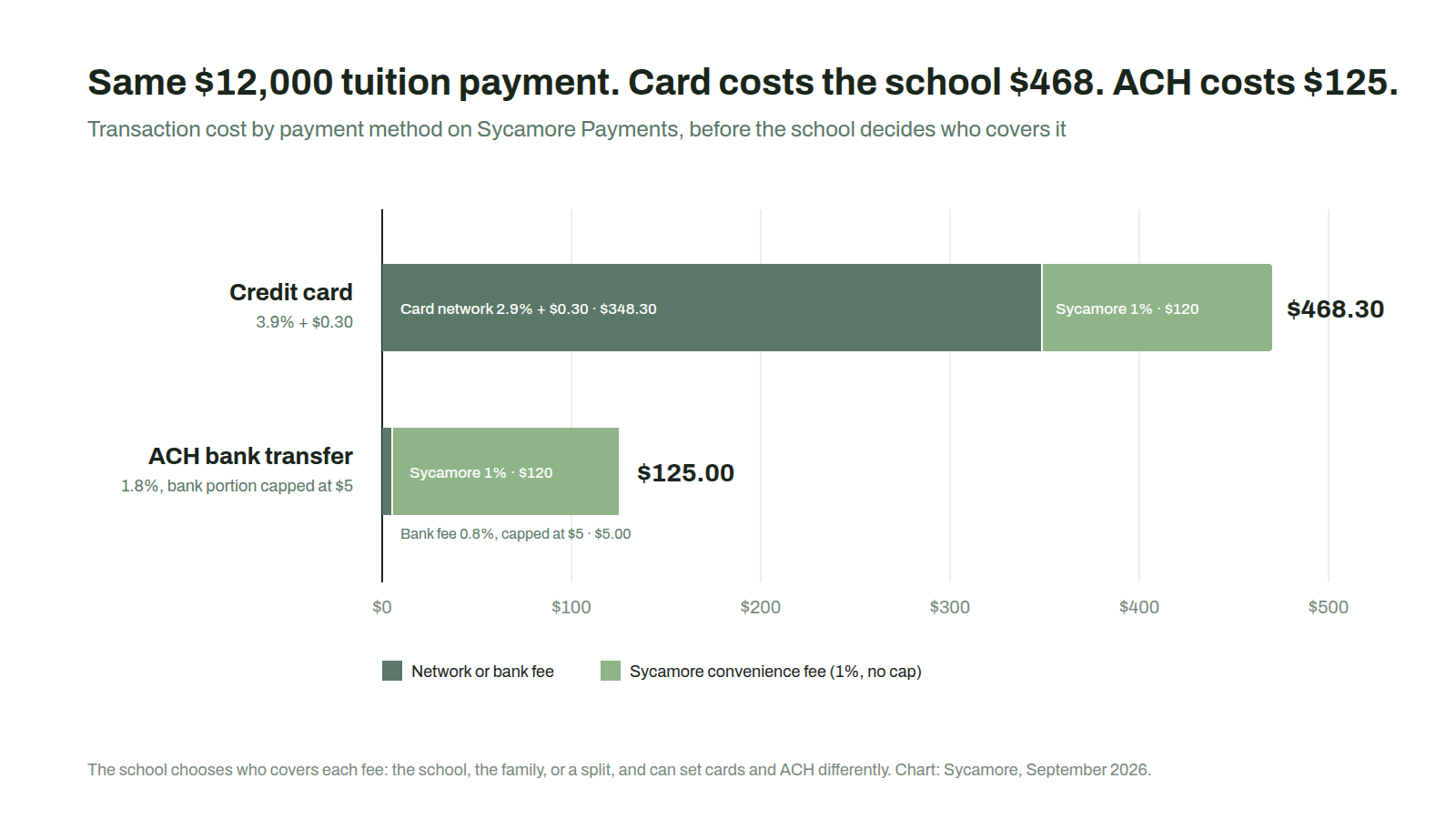
That’s why, of all the K-12 education technology a school buys, the tuition tools inside the SIS matter more than the gradebook when you’re comparing platforms. The gradebook doesn’t have a fee schedule.
When I sit with a business manager and run a student information system comparison, we skip the feature grid and go through seven questions. Each one is a place where the platforms below actually differ.
Is billing computed on the student record? The invoice should be generated from the enrolled student, the family, and the aid award, in one place. If billing lives in a separate product, the aid award has to be keyed in twice.
Can the school set up payment plans without a second vendor? Monthly, quarterly, ten-pay, custom start dates. Common, but not universal.
Do aid awards and sibling discounts flow into the plan automatically? A family with three children on three different awards is an ordinary Tuesday at a private school. It breaks half the systems on this list.
Who decides who pays the transaction fee? Some platforms treat the fee as fixed. A few let the school absorb it, pass it to families, or split it, and set cards and ACH differently. That’s real money at any school collecting a few million a year.
Is tuition refund protection available inside the enrollment flow? Families increasingly expect it; schools like it because it reduces mid-year write-offs.
Can a parent see their balance and pay in the same app where they see grades? If tuition is a separate login, the office becomes the help desk between the two.
Does the ledger reconcile without a spreadsheet? Payments should post to the same ledger the business office closes each month.

Sycamore runs payments natively; the company acquired TuitionEP in 2025 and folded it into the platform. Billing, payment plans, aid awards, and sibling discounts are all computed on the student record, and a change to a plan in November shows in the family’s app the same minute. The school chooses who absorbs the fee, and can absorb ACH while passing card fees to families, which is the setup most business managers land on once they see the math above. Tuition refund protection through Vertical Insure was added to the enrollment flow in 2026. The Sycamore Parent App shows balance, attendance, grades, and school messages behind one login. Pricing is published at $4 per student per month with all modules included, and contracts start at an 18-month minimum with rate locks on longer terms.
Where it isn’t the answer: a large development office living inside Raiser’s Edge, or a boarding school that needs Veracross-grade scheduling.
FACTS is the tuition incumbent in Catholic, Lutheran, and evangelical schools, and for good reason. Tuition Management, Grant and Aid, and Nelnet processing are mature, and thousands of business managers have run them for a decade. The catch is structural. FACTS SIS is the former RenWeb, bought in 2014, and the tuition products were built before it. Families often manage tuition and school information in experiences built at different times, and the SIS, enrollment, and financial modules are quoted separately. Fee handling is less flexible than Sycamore’s. If your school already trusts FACTS with its money and mostly wants one vendor, it’s a reasonable place to stay. If you want tuition on the same record as everything else, it’s the question to press on the demo.
Blackbaud Tuition Management is the former Smart Tuition, and Financial Aid Management the former Smart Aid. Both are capable and both have long histories. They live inside a family of products (SIS, LMS, Enrollment Management, Raiser’s Edge NXT) that each hold their own data, and families with children at more than one Blackbaud school report needing separate logins. Pricing is quote only, standard agreements run three years with automatic renewal, and card processing is competitive on rate. The reason to choose Blackbaud is Raiser’s Edge, which remains the fundraising standard for large development offices. If advancement drives your budget more than tuition does, that can outweigh the rest.
Veracross bills natively and well, with the reporting depth you’d expect from the top of the market. Payment processing runs through integrations rather than a Veracross-owned processor, so the fee schedule and the family’s payment experience depend on which partner the school chooses. The parent-facing mobile experience is the platform’s most criticized area. For a large independent or boarding school with a dedicated Veracross administrator on staff, the tuition tools are strong. For a 250-student day school, you’ll pay for a lot of configurability you won’t use.
Gradelink’s tuition tooling is a basic accounts receivable ledger with payments handled by a third-party processor. It’s fine for simple tuition at a school under about 150 students, and thin for aid, discounts, or plan changes. The parent app is well liked and support is excellent. Admissions and SMS are paid add-ons, and pricing is published in tiers from around $121 a month, month to month.
Alma has a native fees module with payment plans and card and ACH processing, sitting inside one of the cleanest interfaces in the category. Schools with complex aid describe it as thin, there’s no donations module or refund protection, and the parent experience is a progressive web app rather than a native one. Pricing is quote only. A good choice for a progressive independent or charter with simple tuition and a strong preference for interface quality.
For a flat fee from $75 a month, SchoolCues covers billing, payments with recurring plans, and donations for micro-schools and small faith-based schools. The team is very small, the Android app is rated well below the category, and there’s no public API. At 40 students the price is hard to argue with. Past 100, schools tend to outgrow it.
Three questions, and the answers you want are short.
If all three answers are what you want, the gradebook comparison can wait.
Which student information systems do U.S. private K-12 schools use most?
FACTS, Blackbaud, Veracross, Sycamore, Gradelink, Alma, and SchoolCues cover most of the market. FACTS is most common in faith-based schools, Blackbaud and Veracross in larger independents, Sycamore in small to mid-sized independent and faith-based schools, and Gradelink and SchoolCues in very small schools.
Do private schools need a separate tuition management system?
Not anymore, provided the school administration software bills natively. Sycamore, Veracross, and Alma do, inside the SIS. FACTS and Blackbaud still sell tuition management as a separate product, which is a legacy of how those companies were built rather than a requirement of the work.
What do SIS payment processing fees cost?
Card fees in the K-12 market generally run 2.9 to 3.9 percent plus a per-transaction charge, and ACH runs well under 2 percent, often with a cap on the bank portion. Sycamore publishes 3.9 percent plus 30 cents on cards and 1.8 percent on ACH with the bank portion capped at $5. Most platforms don’t publish their schedule, so ask for it in writing.
Is ACH or credit card better for tuition payments?
ACH, almost always. On a $12,000 payment the difference on Sycamore is $468.30 versus $125. Schools that steer families toward bank transfer, and pass card fees to families who insist on cards, keep the most tuition.
How long does it take to switch student information systems?
Four to eight weeks from signature to go-live is realistic for a typical independent school when the historical data is clean. Migrations that bring years of financial ledger history run longer, and a summer go-live is far safer than a fall one.
Dr. Ryan Lowe is a fintech and education consultant who has led Sycamore’s payments strategy, including the acquisition of TuitionEP and the launch of Sycamore Payments. To talk through your school’s tuition setup, call Client Strategy at +1 (402) 442-1499 or request a demo.
Sycamore has served private and faith-based K-12 schools since 2001 and today supports more than 100,000 students in over 40 countries. Request a demo if you’d like to see tuition, aid, and payments run on one record.
Which all-in-one school management software actually runs admissions, enrollment, billing, and the SIS on one record for independent K-12 schools, and which only looks like it does.
Seven independent school management software platforms compared on admissions, SIS, and billing on one record, what they cost, and fit for growing schools.
Twelve criteria for choosing a student information system for an independent school, the question to ask on each, and the answers that should worry you.