Admissions

Which all-in-one school management software actually runs admissions, enrollment, billing, and the SIS on one record for independent K-12 schools, and which only looks like it does.
Every vendor selling all-in-one school management software says the same thing about itself. Very few pass the test that matters, which is whether an inquiry can become an enrolled, billed, paying student without anyone in your office retyping the family. In 2026, Sycamore is the clearest case of admissions, enrollment, billing, payments, and the student information system running on one record. Veracross and Alma run most of the workflow natively. FACTS and Blackbaud are suites of separately built products that share a login. Gradelink and SchoolCues are all-in-one for very small schools, with admissions or payments as add-ons. If you only have time to check one thing on a demo, watch what happens to the family record between the application and the first tuition payment.
Sycamore publishes this guide, so you know where we land. What we can promise is that the all-in-one test below is one a school can run on any platform, ours included, and that the vendor notes come from public pricing, product pages, and the schools that have moved to us from those systems.
Because “generic” usually means built for a public district or for a college, and neither of those has your business model. A district doesn’t sell seats. A college has a bursar’s office with a dozen people in it. You have a registrar, a business manager, maybe an admissions director, and a head of school who signs the contracts.
The failure shows up as hours, not features. Generic school administration software handles grades and attendance fine, then leaves tuition to a spreadsheet, admissions to a form tool, and family communication to whatever email service someone set up in 2019. Every one of those keeps its own copy of the family, and somebody has to keep the copies matching. This isn’t unique to schools. In a June 2025 EDUCAUSE poll of higher education institutions, siloed data across departments was the single most cited barrier to using data well, named by 51 percent of respondents, ahead of budget. Colleges with real IT departments can’t solve it by hiring. A school with a three-person office certainly can’t.
The other thing generic software gets wrong is scale of assumption. Two out of three U.S. private schools enroll fewer than 150 students, according to the federal Private School Universe Survey. Software designed for a 40,000-student district assumes a central office you don’t have.

We use the phrase too, so here’s the standard we’d want to be held to. All-in-one software for independent schools earns the label when five handoffs, from admissions and enrollment management through billing, happen without a human moving data by hand.
Inquiry to application. A family who fills out an inquiry form shouldn’t retype their names, address, and children when they apply.
Application to enrollment contract. An accepted applicant becomes an enrolled student with one action, and the contract pulls tuition, fees, and the family’s aid award from the same record.
Contract to tuition plan. The signed contract creates the billing schedule. Nobody keys invoice lines into a separate billing product.
Tuition plan to payment. The family pays inside the same login where they see grades and attendance, and the payment posts to the same ledger the business office reconciles.
Student record to everything else. A phone number changed in the parent app is the phone number the nurse sees, the teacher sees, and the emergency contact list prints.
The U.S. Department of Education’s research arm has funded state projects for years on exactly this problem, because manual data entry between school systems is, in its words, time consuming and prone to error. Districts fix it with interoperability standards and grant money. Independent schools fix it by buying a platform where there’s nothing to interoperate.
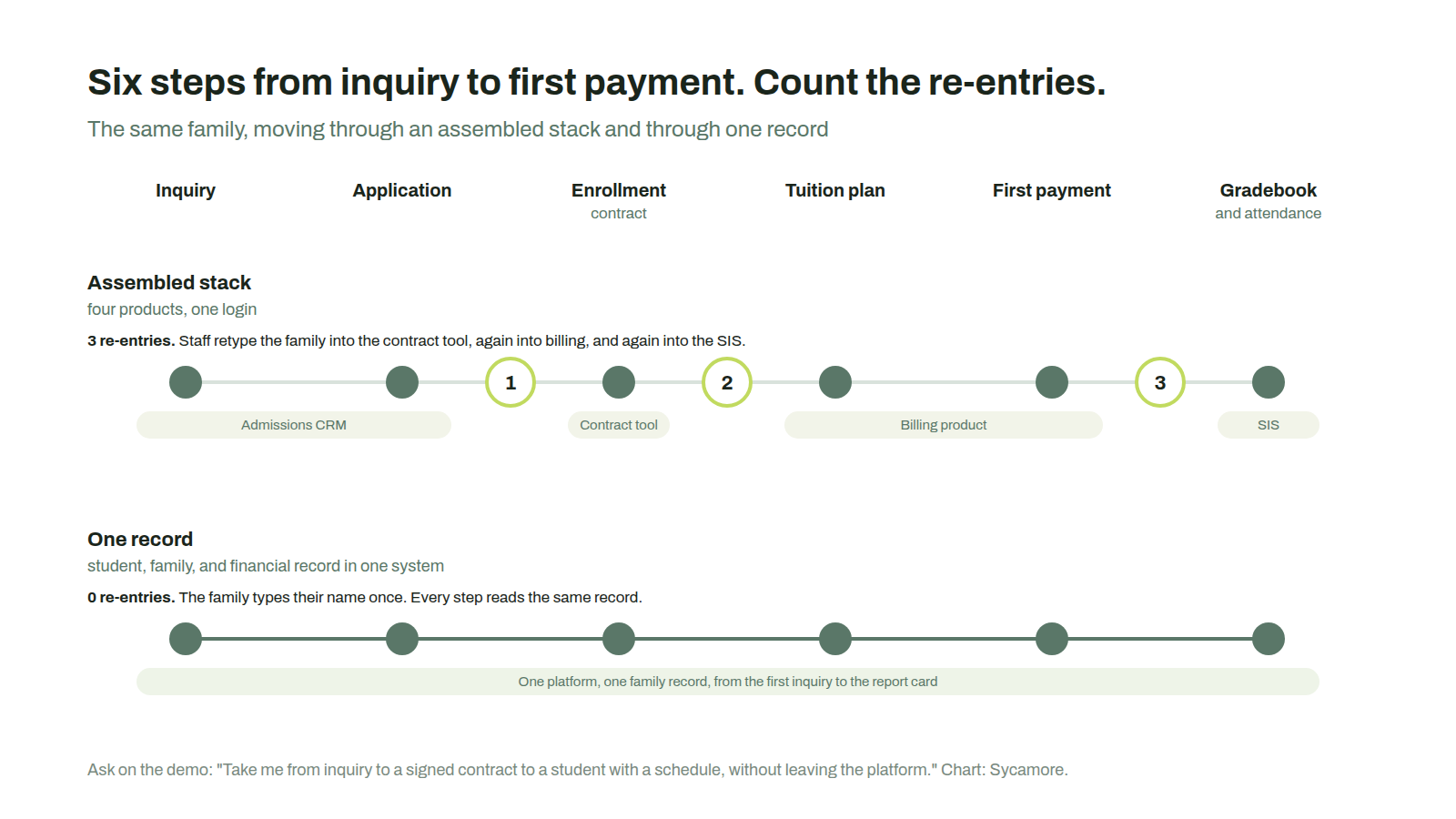
Here’s how the platforms independent schools shortlist most often score against those five handoffs. “Native” means it happens on one student record with no export or sync. “Add-on” means the capability exists as a separately priced module or a partner product. “Suite” means the vendor sells it, but as a distinct product with its own data, the way standalone school billing software does. Everything reflects public documentation as of September 2026, and you should confirm the details on your own demo.
| Platform | Inquiry to application | Application to enrollment | Contract to billing | Billing to payment | One record throughout | Verdict |
|---|---|---|---|---|---|---|
| Sycamore | Native | Native | Native | Native, owned processing | Yes | All-in-one |
| Veracross | Native | Native | Native | Via integrations | Yes | All-in-one, premium |
| Alma | Native (AlmaStart) | Native | Native fees module | Native | Yes | All-in-one, lighter billing |
| FACTS | Separate module | Separate module | Suite (Tuition Management) | Native (Nelnet) | No | Suite |
| Blackbaud K-12 | Suite (Enrollment Management) | Suite | Suite (Tuition Management) | Native | No | Suite |
| Gradelink | Add-on (EnrollMe) | Add-on | Basic ledger | Third-party processor | Partly | All-in-one for very small schools |
| SchoolCues | Native | Native | Native | Native | Yes | All-in-one for micro-schools |
Two things jump out of that table. The platforms that pass cleanly were built for independent schools from the start, and the ones that don’t are the two biggest names in the category. That’s not an accident. FACTS grew out of tuition management and bought its SIS. Blackbaud assembled its K-12 line from acquisitions, and the product names still tell you which company each one used to be. Both are capable. Neither is one system, and their own pricing sheets say so.
The one your office can run without an IT department, which comes down to three things that never make the feature list.
Somebody picks up the phone. Ticket-only support is fine for a college. For a registrar with a report card deadline, it’s a day lost. Sycamore, Gradelink, and Alma all offer phone support at every tier. Veracross is ticket and email. Blackbaud’s premium support sits behind a paid tier.
A new hire can learn it in a week. Independent schools turn over front-office staff more than they’d like. On-demand training that a replacement can open on a Tuesday night is worth more than a training day the vendor quotes in year two. Sycamore Academy is included; several competitors bill training as professional services.
One login for families. If parents use one app for grades and another for tuition, the office becomes the help desk between them. This is where Sycamore, Gradelink, and SchoolCues (native apps) separate from Alma (a progressive web app) and from Blackbaud, where families with children at more than one school report needing separate logins.
We’d put Sycamore first for a typical independent school on this question, and we’d say Gradelink is a fair answer for a school under 100 students that doesn’t need admissions or aid workflows yet.
Under about 100 students, price beats breadth, and two platforms win on price: Gradelink, with published tiers starting around $121 a month, and SchoolCues, flat from $75 a month. Both are legitimately all-in-one at that size, in the sense that a 60-student school can run grades, attendance, report cards, basic billing, and a parent app inside them.
The reason to look at Sycamore even at that size is what happens at 150 or 250 students. Gradelink’s admissions, SMS, and payments are paid add-ons, so the all-in price climbs with the school. SchoolCues is run by a very small team. The migration a growing school avoids by choosing the platform it will still be on in five years is usually worth more than the monthly difference. If you’re small and staying small, take the cheaper platform and don’t look back.
Ask for three things and don’t accept a slide in place of any of them.
For the fuller twelve-question version, including contract terms and migration scope, see What Independent Schools Should Look for in an SIS.
What is the best school management software for independent K-12 schools?
For most independent schools between 50 and 1,200 students, it’s the platform that runs admissions, enrollment, billing, payments, and the SIS on one student record at a published price. Sycamore is the strongest fit on that definition in 2026. Veracross is the premium choice for large independents with staff to run it, and Gradelink or SchoolCues fit very small schools. We compared all seven by school size in Best School Software for Independent K-12 Schools.
Is “all-in-one” school software really one system, or just one login?
Often just one login. The test is whether admissions, enrollment, billing, and the student record share a single database. If the vendor describes modules that “sync” or “integrate,” they’re separate systems behind a shared sign-in.
Do independent schools need a separate admissions CRM?
Not if the SIS runs admissions natively. Sycamore, Veracross, Alma, and SchoolCues do. FACTS and Blackbaud sell admissions as separate products, and Gradelink sells it as an add-on. A separate CRM means re-entering every accepted family each spring.
What does all-in-one school management software cost?
Published per-student pricing for K-12 private school software runs from about $3 to $8 per student per month with wide variation in what’s included. Sycamore lists at $4 per student per month with every module included. FACTS, Blackbaud, Veracross, and Alma quote on request, and the quote usually adds up module by module.
Can a small school grow into an all-in-one platform later?
Yes, but it means migrating. Historical grades, transcripts, and the financial ledger have to move, and a migration in the fall is a lot harder than one in June. Schools that expect to grow past 150 students tend to do better choosing the platform they’ll still be on at 400.
Michaela Lamb, M.Ed., is Director of Client Strategy at Sycamore. She works with independent and faith-based schools on platform fit and pricing, which mostly means helping them figure out what to ask before they sign anything. Book time with Michaela or call Client Strategy at +1 (402) 442-1499.
Most decisions about all-in-one school management software go wrong at the seams, not in the feature list. The independent school software buyers who get this right aren’t the ones that bought the most modules. They’re the ones that counted the re-entries before they signed, and picked the platform where the count was zero.
Sycamore has built for independent and private K-12 schools since 2001 and supports more than 100,000 students in over 40 countries. If you’d like to run the five-handoff test on us, we’d welcome it. Request a demo.
Which K-12 student information systems do U.S. private schools use, and how do their tuition, payment, and aid tools compare? Seven platforms, tuition first.
Seven independent school management software platforms compared on admissions, SIS, and billing on one record, what they cost, and fit for growing schools.
Which SIS do U.S. private K-12 schools use? Seven systems scored on tuition management, parent communication, and all-in-one administration.