Guide

I’m Director of Revenue Generation at Sycamore, so yes, I’d like your network to pick us. That’s exactly why everything below about the other platforms comes from their own websites and help documentation as of November 2026, and why we’ve said where they do something better.
For a network of K-12 schools, the best campus management software gives the central office one view across every school while each school keeps its own schedule, grading, and branding, and it handles four things without bolt-ons: centralized operations, parent access, payments, and student records. Here’s how the main platforms fit:
If you’re one school on two or three campuses rather than a network of schools, start with our multi-campus comparison instead.
A network isn’t just a bigger school. Each school usually has its own head, budget, calendar, and often its own tuition, but the families, the reporting, and the board’s questions cross every one of them. Single-school systems handle the first part. Networks need the second.
Networks are also where a lot of growth is. ISC Research counts 15,075 international schools worldwide, and its 2026 global snapshot puts around 40 percent of them in a school group. In the U.S., the National Catholic Educational Association counts 5,829 Catholic schools across 176 dioceses for the 2025-26 school year. And in England, as of December 2025, 83.9 percent of secondary academies belong to multi-academy trusts, according to the Department for Education.
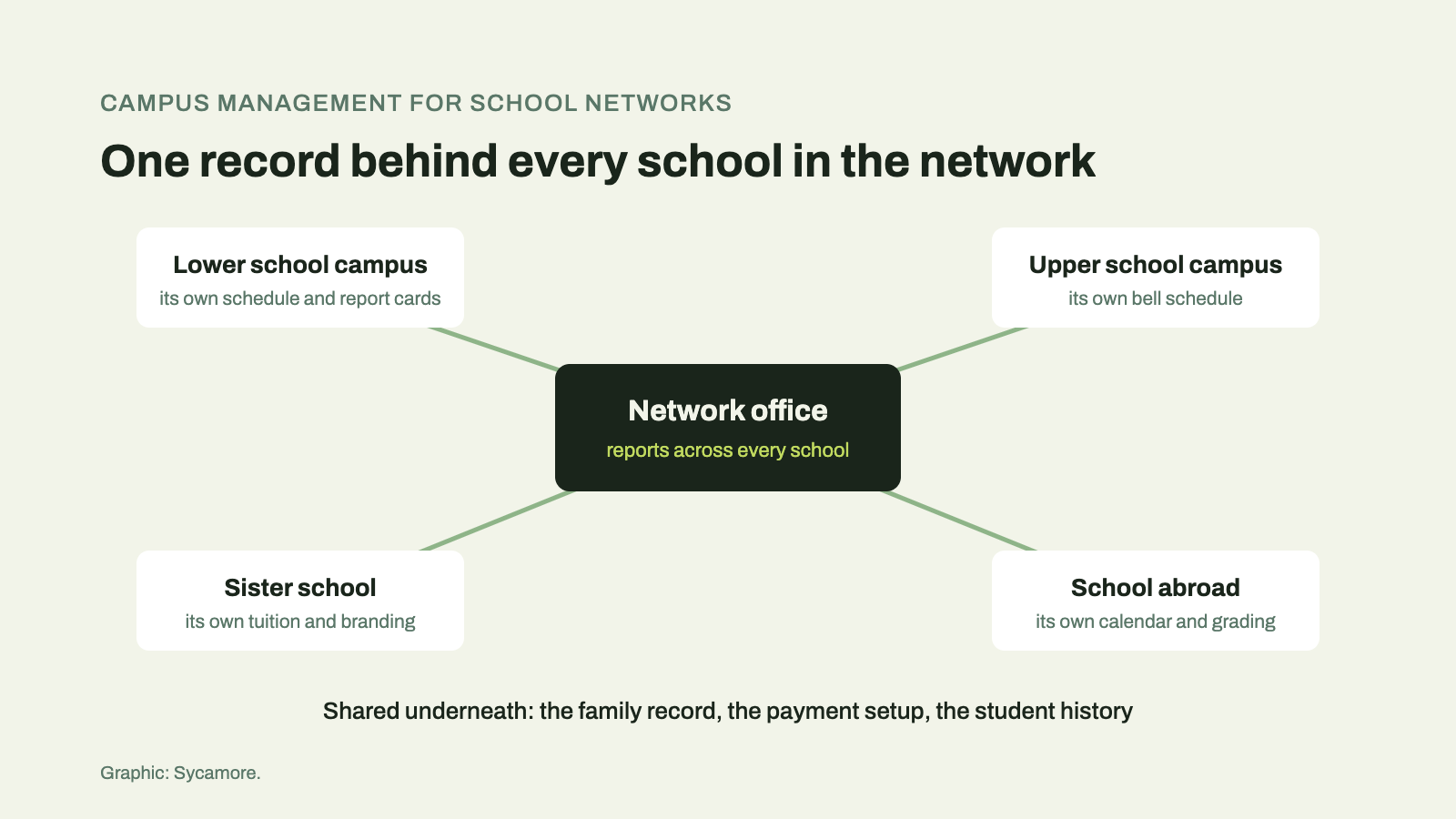
The network office should see enrollment, attendance, finance, and academic results across every school, and drill into one, without emailing each campus for a spreadsheet. Ask how settings get standardized across schools, who can change them, and whether each school can still run its own bell schedule and report cards.
Families with children at two schools in the same network shouldn’t need two apps or two logins. Ask what a parent sees when siblings attend different schools, and whether the app works in the languages your families speak.
Ask whether tuition and fees are collected in the platform or through a partner, whether each school can keep its own tuition and books, and who pays the processing fee. On Sycamore Payments, a card costs 3.9 percent plus 30 cents and ACH costs 1.8 percent, with the 0.8 percent banking portion capped at $5, so the effective ACH rate drops on larger tuition payments. Each school picks one of four ways to fund that: absorb it, split it down the middle, have families cover it through direct pay, or mix by method, such as covering ACH while families cover cards. Cards and ACH are set separately. For international groups, also ask which currencies and countries are supported.
When a student moves from the lower school to the upper school, or from one sister school to another, the record should move with them: grades, attendance, health, and the family’s billing history. Ask what happens to a transfer, and whether two schools in the network end up with two copies of the same family.
Here’s how seven platforms describe their network capabilities on their own sites as of November 2026. “Not published” means we couldn’t find it, not that the feature doesn’t exist.
| Platform | Best fit | Central office view | Parent access | Payments | Pricing |
|---|---|---|---|---|---|
| Sycamore | Private, faith-based, and international schools and networks | Rolled-up enrollment, attendance, finance, and academics; one database | One parent experience across every school; iOS and Android app | Built in; school picks who pays fees, set separately for cards and ACH | Published: $4 per student per month; network discounts |
| iSAMS | International school groups | Central Manage; group-wide analytics | Multilingual parent app, including Arabic | Stripe; multi-currency through a payments partner | Quote |
| PowerSchool | Public districts and large systems | District-level setup | Mobile app; multiple languages | Through partners | Quote |
| Tes Engage | Independent and international schools | One system across schools | Engage Parent App | Built in; Stripe and direct debit | Quote |
| Veracross | Private and international schools | One-person, one-record database; group features not published | Role-based portals | Built in | Quote |
| Classter | Multi-campus K-12 and higher education | Unified dashboards across campuses | Parent portal | Built in; multi-currency | Quote |
| Arbor | Multi-academy trusts in England | Trust-wide reporting and dashboards | Not published | Separate payments product | Quote |
Sycamore for networks puts every school on one secure database. The central office gets rolled-up enrollment, attendance, finance, and academic reporting, while each school keeps its own identity, branding, and local setup. Admissions, billing, and communication follow the same workflows across schools, and families get one parent experience across the network, with grades, attendance, and payments in the same parent app. Sycamore serves schools in over 40 countries, and its international setup handles multiple divisions and standards-based, letter, or hybrid grading. Pricing is published at $4 per student per month, with volume discounts and reduced onboarding fees for networks. International groups should confirm their countries early, since Sycamore Payments is available only where it’s enabled.
iSAMS has gone furthest on group features. Its Central Manage tool, launched in March 2026, lets a central team push standardized settings to every school, with group-wide dashboards alongside. Its customers include Inspired, which runs 119 schools across 27 countries, and its parent and student apps are multilingual, including Arabic. Payments run through Stripe, and a partnership announced in 2026 adds multi-currency processing. Pricing isn’t published.
PowerSchool shows up in nearly every AI answer to this question, mostly because of its weight in U.S. public districts. It serves more than 95 countries and territories, offers a mobile app in multiple languages, and is built around district-level administration. For private networks, look closely at payments: we didn’t find tuition billing described as part of the SIS, and PowerSchool lists partners such as EduTrak for it.
Engage, now part of Tes, is built for independent, fee-paying, and international schools, with a parent app, Stripe payments, and direct debit for fees. Its clearest network example is XCL Education, which runs 18 K-12 schools across Thailand, Vietnam, Malaysia, and Singapore on one system. We didn’t find a dedicated central-office module described on its site.
Veracross serves more than 3,200 schools in over 60 countries, with a database where every person exists exactly once, which helps when families span campuses. Fees management and role-based portals are built in. We didn’t find multi-school group features or multi-currency billing described on its own pages, so ask.
Classter describes one centralized database with shared academic rules, unified dashboards across campuses, and multi-currency, multilingual, and time-zone support, and it has a case study of a group running eight schools in Oman. It serves higher education and corporate training as well as K-12, so check how much of the product is built for schools.
Arbor is the specialist for multi-academy trusts in England, with trust-wide reporting, trust-level dashboards, and central HR records, and it says it has moved more than 925 trusts onto its platform. Outside the U.K. it’s not really an option.
Both come up a lot with international groups. Faria’s OpenApply and ManageBac handle admissions and learning, and Toddle connects to an SIS rather than replacing one. They’re good companions to a campus management platform, not substitutes for one.
It’s a school management platform that runs several schools on one system: admissions, student records, attendance, grades, parent communication, and often tuition, with a central view for the network office and local control for each school.
For U.S. public districts, it’s the most common choice. Private and international networks that collect tuition should compare how much of billing and payments PowerSchool handles directly versus through partners.
On the better platforms, yes. Ask to see two schools with different tuition schedules and different branding running side by side.
If your schools collect fees in more than one currency, yes. Ask each vendor which currencies and countries their payments support today, not on the roadmap.
A multi-campus school is one school in several places. A network is several schools under one umbrella, each with its own leadership and budget. Our multi-campus comparison covers the single-school case.
Johnny Helenek is Director of Revenue Generation at Sycamore. If you’re weighing a move for a group of schools, he can walk your team through how Sycamore would run across your network. Request a demo to get started.
If you’re comparing platforms for a group of schools, we’re glad to show you how Sycamore would handle your central office and each campus. Request a demo for your network.
Which student information system integrates tightly with Google Classroom? Ten SIS compared on Google partner status, what syncs, and required licenses.
How should K-12 schools choose an online training hub for staff? Ten staff training platforms compared on onboarding, compliance, coaching, PD tracking, and price.
What’s the best campus management software for multi-campus schools and school networks? Seven platforms compared on centralized enrollment, tuition, family accounts, and network reporting.